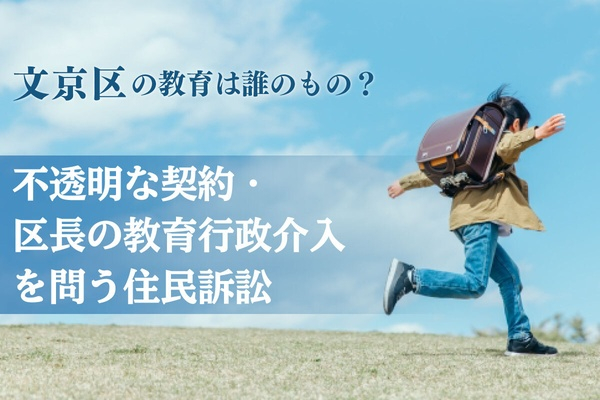
不透明な契約・区長の教育行政介入を問う住民訴訟 〜文京区の教育は誰のもの? Lawsuit Challenging Untransparent Contract Procedure and Mayoral Intervention ~ Whom is Bunkyo Ward’s Education for?
#公正な手続
#Procedural Justice
現在の寄付総額 Current Total Raised
70,000円 ¥ 70,000
目標金額 Target amount
500,000円 ¥ 500,000
サポーター Supporter
6 人 6 supporters
 寄付する
Donate Now
寄付する
Donate Now


現在文京区は、教育行政の目玉「世界に向けた学びを紡ぐプロジェクト」として国際バカロレアの教員研修を推進しています。しかしこのプロジェクトは必要性も効果も十分に説明されていないだけではなく、区長と知人関係にある業者との随意契約など手続き上の問題点があります。不透明な行政手続きを正し、区政の透明性と教育の専門性を守るための裁判です。 As part of its high-profile policy, “Project for Spinning Education Toward the World”, Bunkyo City is promoting International Baccalaureate (IB) teacher training. However, there has been insufficient explanation regarding the project’s necessity and effectiveness. Furthermore, there are problems in the the administrative process such as no-bid contracts with a supplier who has personal ties to the mayor. This public lawsuit aims to correct untransparent administrative procedure and to ensure both transparency of municipal governance and specialty of education.
はじめに
私は文京区で中学生と保育園児を育てる母であり、LINEオープンチャット「文京区議会を見守る会」の管理人です。
区政の情報公開請求や議会の検証を続ける中で、文京区の教育行政のあり方に強い疑問を持つようになりました。今回の住民訴訟は、単にお金の使い方を問うものではありません。教育という重要な分野において、不透明な意思決定が行われていないかを問うものです。
今文京区は、教育行政の目玉として「世界に向けた学びを紡ぐプロジェクト」を推進しています。具体的には国際バカロレアの教員研修です。2025年7月にはシビックホールでシンポジウムを行い、「文京区の小学校でバカロレア教育が受けられるようになるのか」「バカロレア認定校ができるのか?(文京区は認定校を作らないとしている)」と先進性に期待した保護者がたくさんいます。ですが、その実現の過程と、肝心の中身については、区民としても保護者としても疑念を抱かざるを得ないものでした。
*国際バカロレア教育:国際バカロレア機構(本部ジュネーブ)が提供する国際的な教育プログラム。グローバル化に対応できるスキルを身に付けた人材を育成するとともに、国際バカロレア(IB)認定校になると、学校は国際バカロレア機構(IBO)が定める教育プログラムを正式に実施できるようになり、高校段階のIB Diploma Programme(DP)では、世界共通資格として海外大学進学などに活用されることもある。
文部科学省IB教育推進コンソーシアムHP
必要性が説明されていない事業
まず、この教員研修がどのようなものか。
区によれば、「幼稚園教諭から管理職まで聞ける汎用性の高い内容」という研修を、
・50人弱に対してオンラインで
・2年間で6つのテーマについて
・1テーマあたり「90分×3コマ」行う
というものです。この規模でどの程度の効果があるのか、この内容で教育が改善されるのか、なぜ今この事業が必要なのかについては、全く説明されていません。
導入した理由について、区は「学力は毎年全国・都平均を上回り私学への進学もトップクラスだが、主体性や課題設定・解決能力、チームワーク等に課題があるのではないか」と主張しています。しかし、区が根拠とした全国学力学習調査でも、文京区の子どもは、例えば「お互いに協力しながら課題の解決に取り組んでいるか」という問いに対して56.1%が肯定的に回答しており、全国平均の46.1%を大きく上回っています。具体的に文京区の子どもの能力のどこに課題を感じたのか、探究心向上のためになぜ「バカロレア一択」になったのかについては、明らかにされていないままです。
この事業を行う動機について、教育委員会で十分な議論がされた形跡がないのです。そのことは、板倉美千代区議も以下のように指摘しています。
「(2023年)11月6日の総合教育会議の中で、お1人の委員さんは全く発言をしていらっしゃいません。その直後の教育委員会、ここでは、教育委員さんお1人は出席していらっしゃいませんでした。(略)この11月6日の総合教育会議と、その直後に行われた教育委員会で、初めてこのことが報告をされたわけですよね」
「資料を送っただけじゃなくて、御意見をきちっといただかなきゃいけないんじゃないですか」
「教育委員会、教育委員さん全員がいるところできちっと議論しないまま、こういう形で進めていくというのは、やはりきちっと区民の皆さんにも知らせていくと同時に、やっぱり認められないと思うし、学校の先生方からももっともっと御意見を聞かなくてはいけない内容だというふうに私は思います」
(文教委員会、2025/2/25)
「資料を送っただけじゃなくて、御意見をきちっといただかなきゃいけないんじゃないですか」
「教育委員会、教育委員さん全員がいるところできちっと議論しないまま、こういう形で進めていくというのは、やはりきちっと区民の皆さんにも知らせていくと同時に、やっぱり認められないと思うし、学校の先生方からももっともっと御意見を聞かなくてはいけない内容だというふうに私は思います」
(文教委員会、2025/2/25)
そして教育委員会でバカロレアの話題が初出となった同月、2023年11月30日に、区長とバカロレア関係者が「初めて」公式に面談した記録で、すでにシンポジウム開催と、教員研修を行うことが決定されていることがうかがわれます。
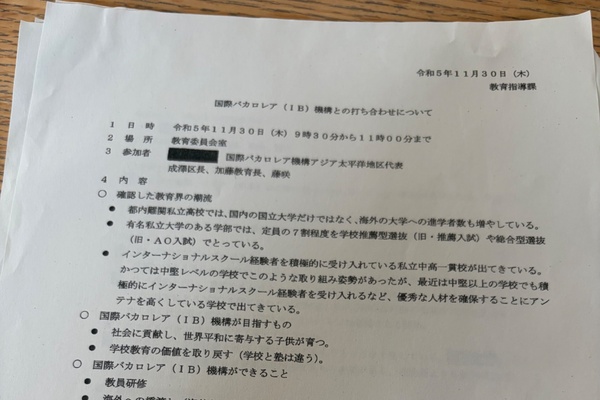
▲成澤区長が出席した会議録だが、区長の発言は一切記録されていなかった。教育委員会で初めてバカロレアについて話された同月の会議であるにもかかわらず、ほぼ事業内容が決まっていることがうかがわれる
随意契約は適切だったのか?
手続き上の問題点も明らかになっています。
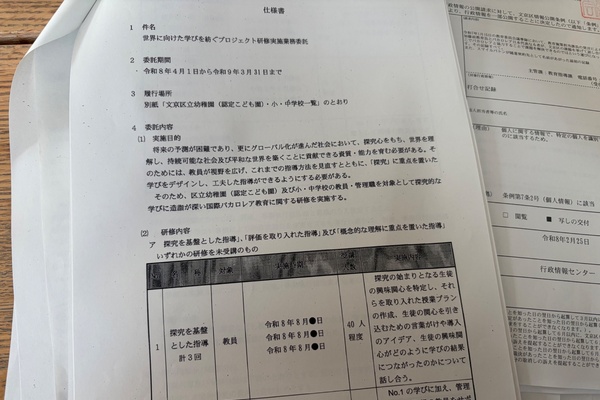
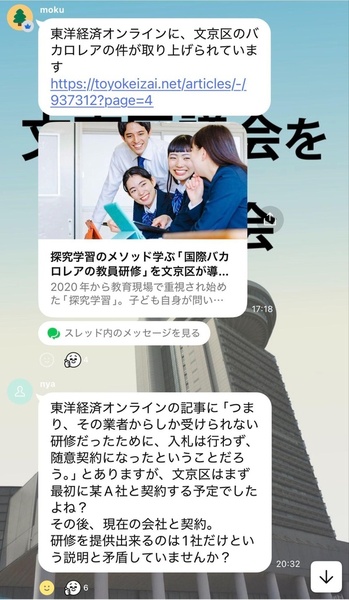
文京区は当初、「この研修は他では実施できない」として、NPO法人スマイルバトンと随意契約を結ぼうとしていました。ところが途中で契約先をシルバーファーンホールディングスに変更し、今度は「シルバーファーン社でなければ実施できない」と説明しました。
しかし、なぜ特定の事業者しか実施できないのかについて、区はどちらとも書面などの客観的資料ではなく、事業者側からの口頭説明だけで判断していました。つまり、本来必要な競争を十分検証しないまま、「他ではできない」として随意契約を進めたことになります。
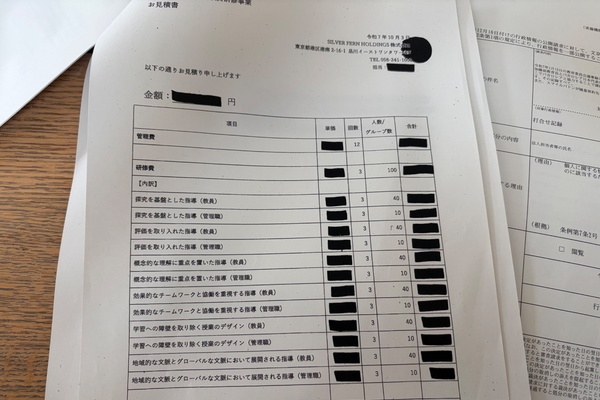
またこの教育研修にはおよそ750万円の委託費用がかけられていますが、その金額についても適正性を検証した資料は見当たりません。シルバーファーン社は人材を抱えていないため、講師は外注となりますが、その人選も黒塗りされていました。
異動前提の教員へ、文京区が研修を行うことへの是非
またそもそも、公立小中学校の教員は区内外への異動が予定(通常6年に達すると異動)されています。先生個人のためにはなるかもしれませんが、区外へ数年で異動するかもしれない教員へ、文京区が研修を行う合理性についての疑問があります。訴訟提起時点では、研修を受けた教員が他の教員へ伝えていくような展開は予定されていません。
区長との関係性と利益相反の疑い
さらに、このシルバーファーンホールディングスの代表者であるW氏は、文京区の成澤区長、そして平成20年から現在まで文京区の教育委員を務め教育長代理でもあるS氏とともに、ある一般社団法人の評議員を務めています。
つまり、随意契約先は「区長の直接的な知人」です。
知人のW代表から今回の研修の話が持ち込まれたことについて、
「自分の中の人間関係の中から紹介し、教育委員会でよく話し合うように言った。IB認定校を作るつもりはないので他に何ができるか考えてほしい」(2025/10/16決算審査特別委員会)
と、区長も議会で認める発言をしています。これは構造としても、関係性に基づく意思決定が疑われる状態です。「よく話し合うように言った」という教育委員会では、前述のように必要性について十分議論された形跡がありません。
知人関係であるならば尚更、さらなる透明性を担保するために、話を持ち込んだW氏が代表を務めるシルバーファーンホールディングスとの契約は、より慎重に合理性を審議し、記録をつけた上で進めるべきだったと思います。
「区長の知人」と随意契約750万円は適正? 文京区の「国際バカロレア」教員研修、業者選びに疑問の声 東京新聞2025年10月31日
教育に、区長が介入していいのか?
今回の経緯を調べた区議複数名は、これは「区長部局の教育行政への直接的な介入である」と何度も議会で追及しています。
教育は、教育委員会で議論されるべきで、これは教育行政の独立性を揺るがす問題です。
教育委員会制度は、教育行政を首長部局から切り離し、専門性と中立性を担保するために設けられたものです。その独立性が形骸化すれば、教育の方向性が短期的な政策判断に左右されかねません。
裁判の争点
今回の裁判は住民訴訟という形で争っており、主な裁判の争点は以下のとおりです。
1 契約には合理性がないこと
今回の事業はIB認定校の設置を目的としない教員向けの研修との位置づけであるが、事業の目的が明確ではない。文京区教育委員会としてその目的などが議論されていない。区の公立中学校・公立小学校の教員は文京区外への異動が予定されており、波及効果は限定されている。
2 「随意契約」の要件を満たしていないこと
ア 国際バカロレアに関する研修以外の可能性が検討されていないこと
イ シルバーファーン株式会社以外で業務が実施できることが検討されていないこと
ウ 委託費用が合理性を欠くこと
これらの違法を理由に、区長、教育長や担当した管理職の責任を追及するとともに、文京区に2026年度以降の同様の契約を行わないように求めるのが今回の住民訴訟です。
なぜ今この訴訟なのか
「国際バカロレアと自治体が初めての協業」と華々しく新聞や雑誌に掲載され「さすが文京区」という印象を与えることはできたかもしれません。
ですが文京区は今、都内でも高い不登校率や、児童数増による万年教室不足、学童の不足、言語ギャップのある外国人児童や特別支援教育の対象児童が増え続ける中受け入れ体制が整っていない、などの喫緊の課題を抱えており、必要性も不透明な事業に税金を使う優先順位は妥当なのでしょうか?
透明性のない手続きが許され続ければ、区政全体が歪んでしまうのではないか。それは直接的に、区民のQOL(生活の質)を左右するという危機感が強くあります。
真に今、文京区の子どもたちに必要な事業を、区長部局からしっかりと独立した教育委員会で話し合ってほしい。そうした願いを込めて、訴訟提起しました。
なお今回の問題は、有志の市民グループ「文京区議会を見守る会」(LINEオープンチャット)でずっと話題になっていたものです。
海津敦子区議が一般質問したこの問題をチャット参加者が拾い、専門家でもない私たちで相談しながら住民監査請求を書きました。そして訴訟費用も、チャット参加者の篤志家が寄せてくれ、まずは提起することができました。
資金の使途について
専門家の意見書の費用、情報公開の実費、運動の活動費、弁護士費用等に活用いたします。詳細な使途はこちらのほか、「文京区議会を見守る会」でも公開する予定です。
担当弁護士のメッセージ
農端康輔(第二東京弁護士会、神楽坂キーストーン法律事務所)
「なぜ国際バカロレアに関する教員研修なのか」「区が研修の実施に関して高額な委託料が支払うのに、区民や区の子供たちに十分な還元がなされるのか」「なぜ区長の知り合いが代表の会社に委託しているのか」、区民の素朴な疑問に答えられない文京区の教育行政に関して問題提起する訴訟です。
行政過程が不透明であり議会を通じた質疑でも明らかにならないことは、文京区に限ったことではなく、他の地方自治体、日本の行政に共通する課題だと思います。
ぜひ自分たちにも関わる問題として、関心をもっていただければありがたいと考えています。
最後に
行政訴訟は問題を世の中に知らしめ、不適切な手続きを抑止する力があると思います。手続きや情報の透明化は、大げさではなく区民の幸せに直結すると、市民運動を通じて強く実感してきました。
訴訟により透明性ある区政に少しでも近づけ、文京区のみならずインパクトを与えていけることを願っています。
ぜひみなさんのお力を貸してください。よろしくお願いいたします。
<文京区議会を見守る会(LINEオープンチャット)>*匿名でお入りいただけます
https://line.me/ti/g2/uX19xiIbh3sgjLRc8Ievl3OVMEF34c_DTmSJSw

Introduction
I am a mother raising a middle school student and a preschooler in Bunkyo Ward, and I am the administrator of the LINE Open Chat "Bunkyo Ward Council Watch Group." Through my continued requests for information disclosure regarding ward administration and scrutiny of the council, I have come to have serious doubts about the way education is administered in Bunkyo Ward. This residents' lawsuit is not simply about how money is spent. It is about whether opaque decision-making is taking place in the important field of education.
Currently, Bunkyo Ward is promoting the "Project to Weave Learning Towards the World" as a flagship initiative in its educational administration. Specifically, it involves teacher training for the International Baccalaureate (IB). In July 2025, a symposium was held at the Civic Hall, and many parents expressed their excitement about the initiative's progressive nature, asking questions such as, "Will Baccalaureate education be available in Bunkyo Ward's elementary schools?" and "Will there be an IB-certified school?" (Bunkyo Ward has stated that it will not create such a school). However, both residents and parents could not help but have doubts about the process of its realization and, more importantly, its content.
* International Baccalaureate Education: An international educational program offered by the International Baccalaureate Organization (headquartered in Geneva). It aims to cultivate individuals with the skills necessary to thrive in a globalized world. When a school becomes an IB-accredited school, it can officially implement the educational program set forth by the International Baccalaureate Organization (IBO). The IB Diploma Programme (DP) at the high school level is a globally recognized qualification that can be used for admission to overseas universities and other purposes.
Ministry of Education, Culture, Sports, Science and Technology IB Education Promotion Consortium Website
Businesses whose necessity has not been explained
First, what kind of teacher training is this?
According to the ward, the training program, which is described as having "highly versatile content that can be heard by everyone from kindergarten teachers to management staff,"
The plan involves conducting online sessions for just under 50 people over two years, covering six themes, with each theme consisting of three 90-minute sessions. There is absolutely no explanation as to what level of effectiveness this scale will have, whether this content will improve education, or why this project is necessary now.
Regarding the reasons for introducing the program, the ward claims that "while academic performance consistently exceeds the national and metropolitan averages, and admission to private schools is among the top, there may be challenges in areas such as initiative, problem-setting and problem-solving abilities, and teamwork." However, in the national academic achievement survey that the ward cited as its basis, 56.1% of Bunkyo Ward children responded positively to the question, for example, "Do you work together to solve problems?", which is significantly higher than the national average of 46.1%. It remains unclear exactly where the ward perceived challenges in the abilities of Bunkyo Ward children, and why they decided on the "International Baccalaureate as the only option" to improve their inquisitiveness.
There is no evidence that the Board of Education had a sufficient discussion about the motivations for undertaking this project. Councillor Michiyo Itakura also pointed this out, as follows:
"At the General Education Meeting on November 6th (2023), one committee member did not speak at all. Immediately afterward, at the Board of Education meeting, that one committee member was not present. (omitted) This matter was first reported at the General Education Meeting on November 6th and at the Board of Education meeting held immediately afterward, correct?"
"Isn't it enough to just send the materials? Shouldn't we also be getting proper feedback?"
"To proceed in this manner without a proper discussion in the presence of the Board of Education and all the members of the Board of Education is something that I believe should be properly communicated to the residents of the ward, and at the same time, I don't think it should be accepted. I also believe that we need to hear more opinions from the teachers at the schools."
(Bunkyo Committee, 2025/2/25)
"Isn't it enough to just send the materials? Shouldn't we also be getting proper feedback?"
"To proceed in this manner without a proper discussion in the presence of the Board of Education and all the members of the Board of Education is something that I believe should be properly communicated to the residents of the ward, and at the same time, I don't think it should be accepted. I also believe that we need to hear more opinions from the teachers at the schools."
(Bunkyo Committee, 2025/2/25)
Furthermore, on November 30, 2023, the same month that the topic of the International Baccalaureate was first mentioned at the Board of Education, records show that the mayor and representatives of the International Baccalaureate had already decided to hold a symposium and conduct teacher training, which marked their "first" official meeting.
▲Although this is the meeting minutes attended by Mayor Narusawa, none of his remarks are recorded. Despite this being the same month that the Baccalaureate program was first discussed at the Board of Education meeting, it appears that the program's details had already been largely decided.
Was the discretionary contract appropriate?
Procedural problems have also come to light.
Initially, Bunkyo Ward was planning to enter into a discretionary contract with the NPO Smile Baton, claiming that "this training cannot be conducted anywhere else." However, they later changed their contracting party to Silver Fern Holdings, and this time explained that "it can only be conducted by Silver Fern."
However, the ward made its decision on why only certain businesses could carry out the work based solely on verbal explanations from the businesses themselves, rather than on objective documents such as written records. In other words, they proceeded with a discretionary contract without adequately examining the necessary competition, simply stating that "no one else could do it."
Furthermore, approximately 7.5 million yen was spent on this training program, but no documentation was found to verify the appropriateness of this amount. Since Silverfern does not employ its own staff, the instructors are outsourced, but the selection process for these individuals was also redacted.
The pros and cons of Bunkyo Ward providing training to teachers who are expected to be transferred.
Furthermore, public elementary and junior high school teachers are subject to transfers within and outside the ward (usually after 6 years). While this may benefit individual teachers, there are questions about the rationale for Bunkyo Ward to provide training to teachers who may be transferred outside the ward in a few years. At the time the lawsuit was filed, there were no plans for the trained teachers to pass on their knowledge to other teachers.
Relationship with the ward mayor and suspected conflict of interest
Furthermore, Mr. W, the representative of Silver Fern Holdings, serves as a councilor of a certain general incorporated association, along with Bunkyo Ward Mayor Narusawa and Mr. S, who has served as a member of the Bunkyo Ward Board of Education and as Deputy Superintendent of Education since 2008.
In other words, the recipient of the discretionary contract is "a direct acquaintance of the ward mayor."
Regarding the fact that my acquaintance, CEO W, brought up the topic of this training,
"I introduced them from my own network of contacts and told them to discuss it thoroughly with the Board of Education. I have no intention of creating an IB-accredited school, so I would like them to think about what else can be done." (Special Committee on Settlement Review, October 16, 2025)
The ward mayor also acknowledged this in a statement made in the assembly. Structurally, this raises doubts about decision-making based on relationships. The Board of Education, which said it "told them to discuss it thoroughly," shows no evidence that the necessity was adequately discussed, as mentioned above.
Especially given the personal relationship, I believe that the contract with Silver Fern Holdings, headed by Mr. W who initiated the discussion, should have been more carefully reviewed for its rationale, documented thoroughly, and proceeded with greater transparency.
Is it appropriate for the ward mayor to intervene in education?
Several ward council members who investigated the circumstances have repeatedly questioned the matter in the council, stating that it constitutes "direct intervention by the mayor's office in educational administration."
Education should be discussed within the board of education, and this issue undermines the independence of educational administration.
The education committee system was established to separate educational administration from the head of the local government's department and to ensure expertise and neutrality. If this independence becomes meaningless, the direction of education could be influenced by short-term policy decisions.
Issues in the trial
This lawsuit is being contested as a residents' lawsuit, and the main points of contention are as follows:
1. The contract lacks rationality.
This project is positioned as teacher training that does not aim to establish IB-accredited schools, but its objectives are unclear. The Bunkyo Ward Board of Education has not discussed its objectives. Teachers from the ward's public junior high schools and public elementary schools are scheduled to be transferred outside of Bunkyo Ward, so the ripple effect is limited.
2. The requirements for a "negotiated contract" are not met.
a. No alternatives to training related to the International Baccalaureate have been considered. b. No alternatives to Silverfern Co., Ltd. have been considered for the work to be carried out by a company other than Silverfern Co., Ltd. c. The outsourcing costs are unreasonable.
This residents' lawsuit seeks to hold the ward mayor, the superintendent of education, and the managers in charge accountable for these illegal activities, and to demand that Bunkyo Ward refrain from entering into similar contracts from fiscal year 2026 onward.
Why this lawsuit now?
The project was featured prominently in newspapers and magazines as "the first collaboration between the International Baccalaureate and a local government," which may have created the impression that "Bunkyo Ward is truly impressive."
However, Bunkyo Ward currently faces urgent issues such as one of the highest rates of school absenteeism in Tokyo, a perpetual shortage of classrooms due to the increasing number of children, a lack of after-school care, and inadequate support systems for the growing number of foreign children with language barriers and children requiring special education. Given these challenges, is it appropriate to prioritize spending taxpayer money on projects whose necessity is unclear?
If opaque procedures continue to be tolerated, the entire ward administration will become distorted. I have a strong sense of crisis that this will directly affect the quality of life (QOL) of the ward's residents.
I filed this lawsuit with the hope that the education committee, which is completely independent of the mayor's office, will discuss the programs that children in Bunkyo Ward truly need right now.
This issue has been a long-standing topic of discussion within the volunteer citizens' group "Bunkyo Ward Council Watch Group" (LINE Open Chat).
This issue, which Councilwoman Atsuko Kaizu raised in a general question session, was picked up by the chat participants, and we, who are not experts, consulted with each other and drafted a resident audit request. Furthermore, generous chat participants contributed funds for the litigation costs, allowing us to file the request.
Regarding the use of funds
The funds will be used for expenses such as expert opinions, actual costs for information disclosure, campaign activity expenses, and legal fees. Detailed information on how the funds will be used will be made available here and also by the "Bunkyo Ward Council Watch Group."
Message from the assigned attorney
Kosuke Nobata (Second Tokyo Bar Association, Kagurazaka Keystone Law Office)
This lawsuit raises concerns about Bunkyo Ward's educational administration, which fails to answer simple questions from residents such as, "Why is the teacher training related to the International Baccalaureate?", "The ward is paying a high fee for conducting the training, but will it be adequately returned to the residents and children of the ward?", and "Why is the contract being outsourced to a company whose representative is an acquaintance of the ward mayor?"
The lack of transparency in administrative processes and the failure to clarify issues through questioning in the assembly are not unique to Bunkyo Ward, but rather common problems in other local governments and in Japanese administration as a whole.
We would be grateful if you would take an interest in this issue, as it concerns you all.
lastly
I believe administrative litigation has the power to bring issues to public attention and deter inappropriate procedures. Through citizen movements, I have strongly come to realize that transparency in procedures and information is, without exaggeration, directly linked to the well-being of the ward's residents.
I hope that this lawsuit will bring us a little closer to transparent ward administration and have an impact not only on Bunkyo Ward but also on other areas.
We would greatly appreciate your support. Thank you very much.
<Bunkyo Ward Council Watch Group (LINE Open Chat)> *You can join anonymously
https://line.me/ti/g2/uX19xiIbh3sgjLRc8Ievl3OVMEF34c_DTmSJSw

有馬美穂
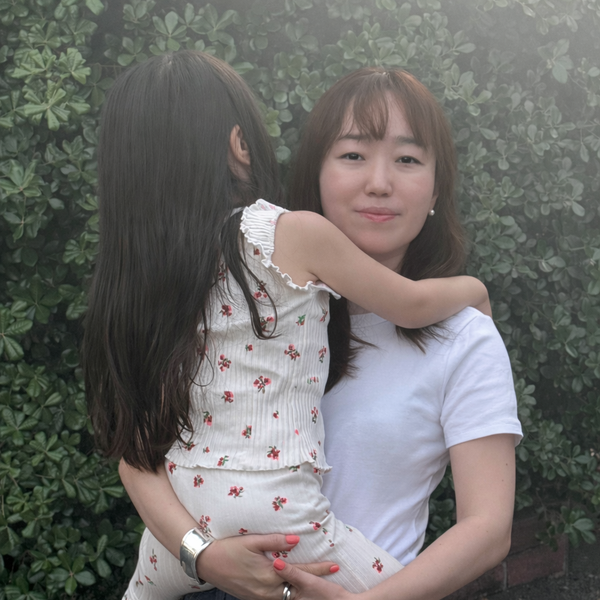
ライター・編集者。1981年埼玉県生まれ。早稲田大学第一文学部卒業、仏留学を経て出版社にて女性ファッション誌制作に携わる。2児の母。2023年4月LINEオープンチャット「文京区議会を見守る会」(5/14現在参加者802名)を立ち上げ、チャットが2025年「民主主義大賞(日本若者協議会主催)」優秀賞受賞。「民主主義ユースフェスティバル2026」に出展。チャットによる“カジュアル版市民オンブズマン”管理人として活動中。
<お問い合わせ>
bunkyo.public.case@gmail.com
<お問い合わせ>
bunkyo.public.case@gmail.com
あなたにおすすめのケース Recommended case for you



- 外国にルーツを持つ人々 Immigrants/Refugees/Foreign residents in Japan
- ジェンダー・セクシュアリティ Gender/Sexuality
- 医療・福祉・障がい Healthcare/Welfare/Disability
- 働き方 Labor Rights
- 刑事司法 Criminal Justice
- 公正な手続 Procedural Justice
- 情報公開 Information Disclosure
- 政治参加・表現の自由 Democracy/Freedom of Expression
- 環境・災害 Environment/Natural Disasters
- 沖縄 Okinawa
- 個人情報・プライバシー Personal information/Privacy
- アーカイブ Archive
- 全てのケース ALL