外国籍住民を排除した、三重県の『差別アンケート』を許さない訴訟 Lawsuit Challenging Mie Prefecture’s ”Discriminatory Survey” Against Foreign Residents
#外国にルーツを持つ人々
#Immigrants/Refugees/Foreign residents in Japan
#公正な手続
#Procedural Justice

現在の寄付総額 Current Total Raised
0円 ¥ 0
目標金額 Target amount
5,000,000円 ¥ 5,000,000
サポーター Supporter
0 人 0 supporters
 寄付する
Donate Now
寄付する
Donate Now


三重県は、県職員採用における国籍要件の復活を検討するため、県民アンケートを実施しました。しかし、外国籍住民は回答対象から除外され、設問も外国籍者を情報漏えいの危険と結び付ける内容でした。本訴訟は、このアンケートが「不当な差別」に当たり、そのための公金支出は違法であると訴える住民訴訟です。 Mie Prefecture conducted a survey of its residents to consider reinstating a nationality requirement for prefectural employee recruitment. However, foreign residents were excluded from the survey, and survey questions link foreign nationals to the risk of information leaks. This lawsuit argues that the survey constitutes an ”unjust discrimination” and that the expenditure of public funds for such survey shall be illegal.
はじめに
2025年12月25日、三重県知事は記者会見で、県庁における情報漏洩対策を理由に、県職員の採用における、国籍要件の復活を検討すると表明しました。この表明は、これまで三重県内において、ともに地域で暮らしてきた外国籍住民の尊厳を揺るがす重大な問題です。
さらに県は、外国籍住民を回答者から除外したアンケートで、外国籍職員の採用継続の是非を問い、その実施に公金を支出しました。さまざまな団体や個人が抗議の声を上げていますが、現在もなお、国籍要件復活の検討は撤回されていません。
私たちは、国籍にかかわらず、誰もが排除されることなく、安心して暮らせる社会をつくり、守るため、2026年6月11日、三重県知事を相手取り、津地方裁判所に住民訴訟を提起いたしました。
これまでの経緯
三重県は1999年度、外国人の社会参画推進などを目的に、一部職種を除いて採用時の国籍要件を撤廃しました。
しかし、三重県知事は2025年12月25日の記者会見で、インフラ強度や農業の新品種開発といった機微情報、並びに地方自治体を経由した国家情報の国外流出を防ぐリスク管理の観点を理由に、国籍要件の復活に向けた検討を表明しました。その背景には国内外の自国民に情報活動への協力を義務付ける諸外国の法律の存在を挙げています。
さらに県は、検討を進めるにあたり、約20年間実施している「みえ県民一万人アンケート」において、県民に国籍要件の復活について考えを問う項目を設計し、実施しました。
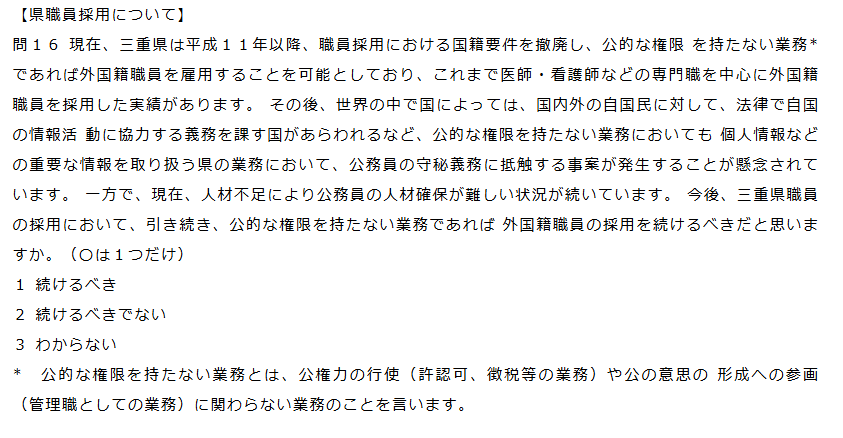
▲「第4回みえ県民1万人アンケート」に設けられた、外国籍職員の採用継続の是非を問う問16
また、アンケートの対象者の抽出に「選挙人名簿」が使用されることによって、アンケートから、地方自治法で「県民」とされている「外国籍住民」は回答者から除外されました。
外国籍住民の権利に関わる問題について、当事者を除外したまま意見を問うことや、外国籍者と情報漏えいの危険を結び付ける設問の内容に対し、弁護士会や人権団体などは「国籍を理由とした不当な排除・差別にあたる」「日本人かどうかにかかわらず守秘義務は等しく課されている」として強く抗議し、撤回を求める声明が相次ぎました。(例:三重県弁護士会による声明、中弁連理事長声明、愛知県弁護士会会長声明、日弁連会長声明)
2026年の夏の県職員採用試験では、従来通り外国籍者の受験を認めることとなりましたが、現在もなお、三重県知事は国籍要件の復活に向けた検討を続けています。
裁判で主張していること
この裁判は住民訴訟という形で争っています。
三重県は、2026年4月28日、「みえ県民1万人アンケート」(以下「本件アンケート」と言います)の業務委託費として742万6100円を支出しました。 原告は、外国籍住民を回答者から排除し、差別を助長する内容を含むアンケートの実施と、そのための公金支出は違法であると主張しています。
その上で、被告である三重県知事に対し、一見勝之氏個人へ、 アンケート業務の委託費相当額の返還を求めています。
原告が主張している主な法的論点は次の4点です。
1. アンケートの回答者から外国籍住民を除外したこと
本件アンケートは、「選挙人名簿」に基づき対象者を抽出したため、外国籍住民が回答者から除外された形で実施されました。
このことは、①平等権を保障する憲法14条1項に反するとともに、②住民として自治体から役務の提供を等しく受ける権利を保障する地方自治法10条2項にも反します。
また、③「差別を解消し、人権が尊重される三重をつくる条例」4条1項が禁ずる「不当な差別」にもあたり違法です。
差別を解消し、人権が尊重される三重をつくる条例
第二条 この条例において、次の各号に掲げる用語の意義は、それぞれ当該各号に定めるところによる。
一 人種等の属性 人種、皮膚の色、国籍、民族、言語、宗教、政治的意見その他の意見、年齢、性別、性的指向、性自認、障がい、感染症等の疾病、職業、社会的身分、被差別部落の出身であることその他の属性をいう。
二 不当な差別 人種等の属性を理由とする不当な区別、排除又は制限であって、あらゆる分野において、権利利益を認識し、享有し、又は行使することを妨げ、又は害する目的又は効果を有するものをいう。
第四条 何人も、不当な差別をはじめとする人権侵害行為をしてはならない。
「不当な差別」の解釈(逐条解説参照)
①正当な理由なく、特定の人種等の属性を理由として、財・サービスや各種機会の提供を拒否したり、提供にあたって場所・時間帯などを制限したり、当該人種等の属性を持たない者に対しては付さない条件を付けたりすることや、②特定の人種等の属性を持つ者に対して、人種等の属性を理由として、その生命などに危害を加える旨を告知したり、著しく侮蔑したり、地域社会から排除したりすること(以上2条2号における不当な差別)、及び③いじめ、虐待、プライバシーの侵害、誹謗中傷、セクシュアル・ハラスメント、ドメスティック・バイオレンス(DV)、パワー・ハラスメント、体罰などの人権侵害行為、対象者の同意のない人種等の属性についての情報収集等や、本人の相違のない属性の暴露(4条1 項参照)
2. 問16の内容が差別や偏見を助長すること
問16は、外国の法律によって情報活動への協力を求められる可能性を説明した上で、外国籍職員の採用を続けるべきかを尋ねています。
⑴ 問16の記載内容
本件アンケート問16の「県職員の外国人採用」に関する設問では、次のとおり県としての「情報提供」が行われていました。
〇「世界の中で国によっては、国内外の自国民に対して、法律で自国の情報活動に協力する義務を課す国があらわれるなど、公的な権限を持たない業務においても個人情報などの重要な情報を取り扱う県の業務において、公務員の守秘義務に抵触する事案が発生することが懸念されています」
◆「一方で、現在、人材不足により公務員の人材確保が難しい状況が続いています」
この2つを提示した上で、「公的な権限を持たない業務であれば外国籍職員の採用を続けるべきか」という設問が示されていました。この外国の法律や情報漏洩への懸念に関する説明について、○の部分 前者は128文字であるのに対し、◆ ○の部分 後者は公務員の人材確保が困難といった内容が36文字しか記載されていません。
問16では日本の法律を遵守せずに情報漏洩を行いうる「潜在的スパイ」「犯罪者予備軍」として、外国籍者を一律に取り扱っていると言わざるを得ません。
そして、本件アンケート公表後、インターネット上では在日外国人をスパイ呼ばわりするような差別的投稿が何倍にも増加し、差別感情が助長され続けています。
⑵ 違法性
問16は記載内容そのものが、①ヘイトスピーチ解消法2条が定める「不当な差別的言動」や、②人種差別撤廃条約にて禁止されている「人種差別」にあたり、違法です。
ヘイトスピーチ解消法(正式名称:本邦外出身者に対する不当な差別的言動の解消に向けた取組の推進に関する法律)
第二条 この法律において「本邦外出身者に対する不当な差別的言動」とは、専ら本邦の域外にある国若しくは地域の出身である者又はその子孫であって適法に居住するもの(以下この条において「本邦外出身者」という。)に対する差別的意識を助長し又は誘発する目的で公然とその生命、身体、自由、名誉若しくは財産に危害を加える旨を告知し又は本邦外出身者を著しく侮蔑するなど、本邦の域外にある国又は地域の出身であることを理由として、本邦外出身者を地域社会から排除することを煽動する不当な差別的言動をいう。
あらゆる形態の人種差別の撤廃に関する国際条約
第1条 1 この条約において、「人種差別」とは、人種、皮膚の色、世系又は民族的若しくは種族的出身に基づくあらゆる区別、排除、制限又は優先であって、政治的、経済的、社会的、文化的その他のあらゆる公的生活の分野における平等の立場での人権及び基本的自由を認識し、享有し又は行使することを妨げ又は害する目的又は効果を有するものをいう。
※2004年に人種差別撤廃委員会は「市民でない者に対する差別に関する一般的勧告30」を採択し、「人権は、原則として、すべての者によって享有されなければならない」とし、「締約国は、国際法に基づいて認められた範囲において、これらの権利の享有における、市民と市民でない者との間の平等を保障する義務を負う」ことを明らかにしました。(参照:https://www.hurights.or.jp/archives/opinion/2004/03/post-4.html )
3. 外国籍者の公務就任権を侵害すること
問16は、「県職員採用の国籍要件の見直し」の検討の目的で挿入されたものであり、憲法14条1項や憲法22条及び人種差別撤廃条約第5条において保障されている外国籍者の公務就任権を侵害し違憲違法です。
あらゆる形態の人種差別の撤廃に関する国際条約
第5条 第2条に定める基本的義務に従い、締約国は、特に次の権利の享有に当たり、あらゆる形態の人種差別を禁止し及び撤廃すること並びに人種、皮膚の色又は民族的若しくは種族的出身による差別なしに、すべての者が法律の前に平等であるという権利を保障することを約束する。
(c)政治的権利、特に普通かつ平等の選挙権に基づく選挙に投票及び立候補によって参加し、国政及びすべての段階における政治に参与し並びに公務に平等に携わる権利
(e)経済的、社会的及び文化的権利、特に、
(i)労働、職業の自由な選択、公正かつ良好な労働条件、失業に対する保護、同一の労働についての同一報酬及び公正かつ良好な報酬についての権利
4. 三重県知事が裁量権を逸脱・濫用したこと
問16は、当初の調査票案や有識者への相談事項には含まれず、 三重県知事の独断専行により公表直前に追加されたものであることや、外国籍者の公務就任権に関する事柄にも関わらず諮問機関に諮問されておらず当事者となる外国籍住民の意見も反映されていないこと等が三重県知事の裁量権の逸脱・濫用を基礎づけます。
また、外国籍者職員の情報漏洩の懸念については、刑法や地方公務員法の守秘義務違反による刑事罰や懲戒処分によって対応可能であり、三重県では外国籍職員が機密情報を流出した事例は存在しないにも関わらず、外国籍者に対する差別意識を助長するアンケートを実施したことは比例原則違反※といえ、この点からも裁量権の逸脱・濫用が認められます。
※比例原則:ある行政目的を達成しようとするとき、より規制の程度が軽い手段で目的を達成できるのならその軽い手段によるべき、という原則です。目的と手段の均衡を要求するものです。
なお、この訴訟は住民訴訟という形式をとっています。三重県は上記アンケートの実施に際し、業務委託費として742万6100円もの公金を支出しました。このことについて原告は、外国籍住民を回答者から排除し、差別を助長する内容を含むアンケートの実施及びこれに係る公金支出は違法であると主張しています。
原告の思い
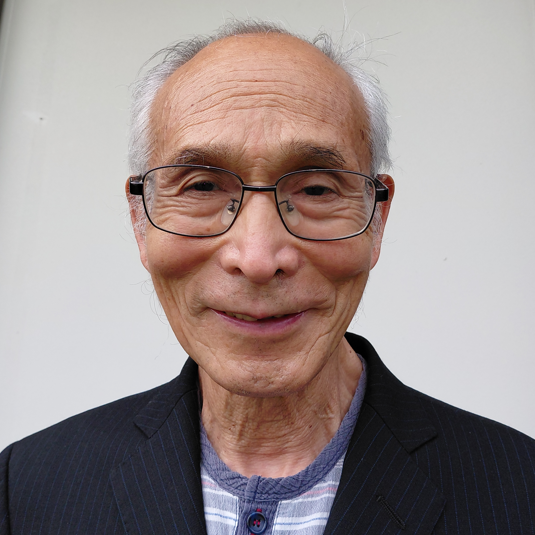
原告 竹本 昇さん
三重県知事は、外国籍の住民は日本の法律を守らず、日本の秘密を漏洩する恐れがあるとの偏見から、外国籍を有する三重県住民を県職員に採用しないというこれまでの方針を逆転させる政策を意図し、今回「三重県民1万人アンケート」を実施しました。
これまで大切にしてきた「差別を解消し、人権が尊重される三重をつくる条例」の理念・精神を著しく後退させるものであり、決して許されません。
真の安全保障は、差別と排外主義ではなく、他の国や他の民族の人たちの人権を尊重し、平和で友好的な関係を築くことによって実現できるものと確信しています。
外国籍を有する県民を回答者からあえて排除し、県職員採用に国籍要件が必要であるとの結論を誘導するかのような「三重県民アンケート」調査は決して容認されるべきではなく、速やかに撤回されるべきです。
社会的意義
この裁判の第一の意義は、行政が外国籍住民に対する偏見を広げ、地域社会の分断を生み出すことを防ぐ点にあります。
三重県は1999年に県職員採用の国籍要件を大幅に撤廃し、外国籍住民を地域社会の担い手として受け入れてきました。ところが、情報漏えいの危険性を国籍と結び付けて採用の門戸を閉ざせば、外国籍者を一律に「危険な存在」として扱うメッセージになりかねません。行政による排除は、職場や学校、地域社会におけるさらなる排除へと連鎖するおそれがあります。
情報漏えいを防ぐことは重要です。しかし、情報漏えいは職員の国籍にかかわらず起こり得ます。必要なのは、職務や取り扱う情報に応じたアクセス権限の設定、守秘義務の徹底、研修、監査など、すべての職員を対象とした実効的な情報管理です。国籍による一律の排除は、公正な対策とはいえません。
また、少数者の権利や尊厳に関わる問題を、当事者を回答者から除外した多数決型のアンケートによって決めてよいのかという、民主主義のあり方も問われています。
人口減少と少子高齢化が進む三重県において、外国籍住民は地域を共に支える重要な存在です。国籍にかかわらず、能力と意欲を持つ人が公務を通じて地域に貢献できる環境を守ることは、行政サービスの質と持続可能性を確保することにもつながります。
この裁判は、国籍で人を疑い、排除する社会ではなく、一人ひとりの尊厳を守りながら、誰もが安心して暮らせる社会を選び取るための裁判です。
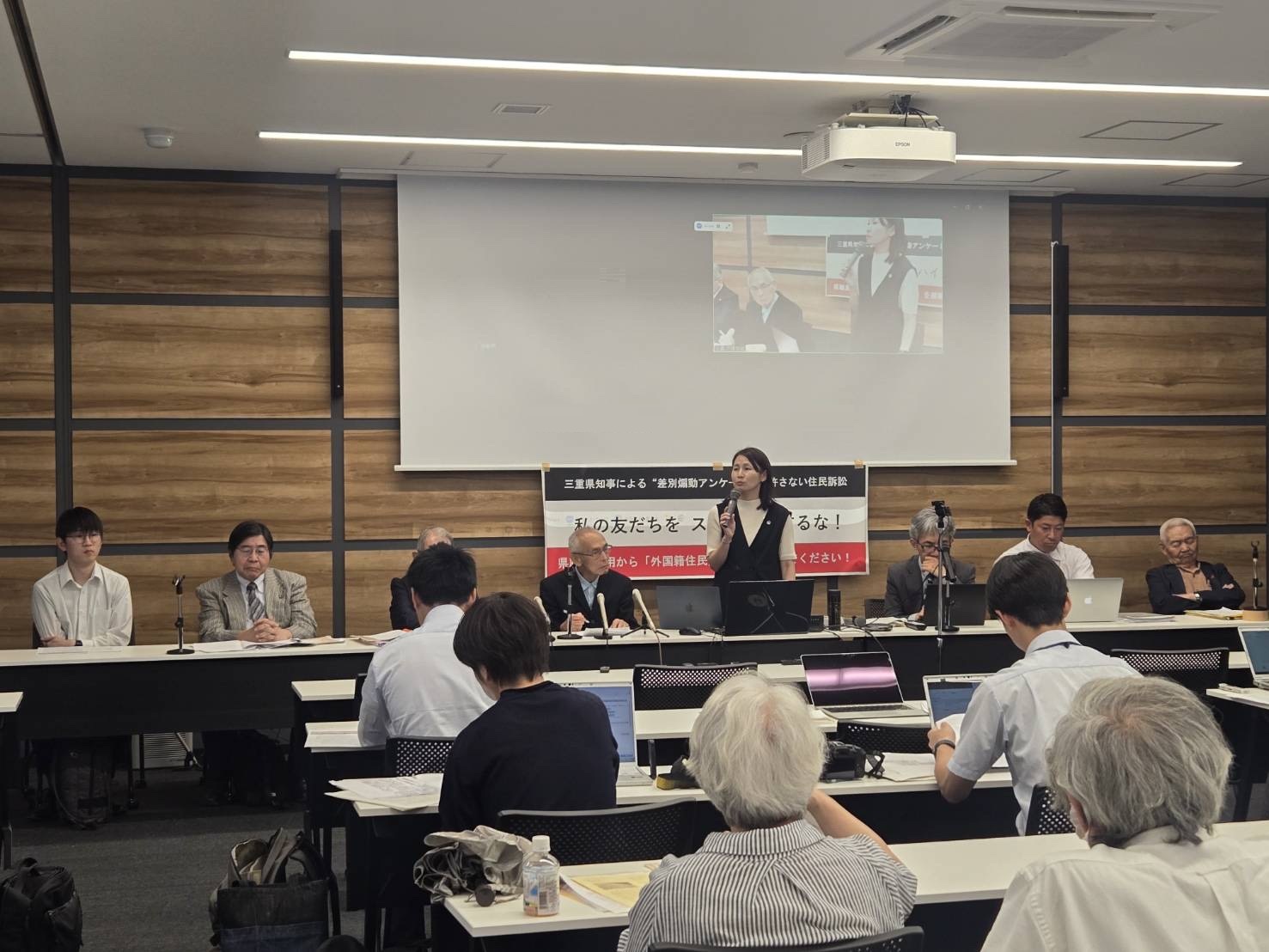
▲提訴報告会の様子
寄付金の使途
訴訟事務費用
弁護団の活動費(交通費、通信費、コピー代など)
意見書費用:専門家に意見書を執筆していただくことを予定しています。
裁判報告集会、本ケースの周知・啓発行事
弁護団報酬等:皆さまから頂いた寄付を上記に挙げた諸費用に充てたうえで、余りがでるようであれば、弁護士費用に充てさせて頂きます。
弁護団長からのメッセージ
「歴史を逆戻りさせないために!」
三重県が1999年に全国に先駆けて県職員の採用条件のうち、日本国籍を有する者に限るとする「国籍要件」を排除ないし緩和したことは画期的な政策であり、深く敬意を表したい。また、包括的反差別条例「差別を解消し、人権が尊重される三重を作る条例」を制定したことは、全国的にも極めて先進的な事柄であり、すべての人を公平にかつ大切にという人権擁護の観点からもまた、国際平和の観点からも高く評価されてきた。特に、近時の人口減少、少子化問題が真剣に問われている時だけに、国籍要件排除の政策の意味は非常に大きなものがあった。
今なぜ「国籍要件復活か?」との深い疑念を抱く。我が国は、戦後世界平和と基本的人権擁護の回復・前進のために努力をし、遅々たるものであったが、その歩みを進めてきた。それが、外国人をも含めた県民の人権を大切にする先進県であるはずの三重県においてなぜ「逆もどり」をするのか、極めて残念な出来事である。何とかその後退を阻止し、三重県に住む人々の人権尊重と差別の解消が一層力強く進められることを心から願いたい。
本件事件の弁護団に参加させて頂いた所以である。
弁護士 内河 惠一
弁護団からのメッセージ
外国籍者の公務就任権は壮絶な差別撤廃運動の歴史の中で勝ち取った権利であり、まさしく共生社会の財産です。安全保障の文脈の中で簡単に奪って良い権利ではありません。
また、今回、三重県はアンケートという手段をとることで、自らの排外主義的政策選択をアンケート回答者である県民に責任転嫁しようとしています。しかし、そもそも、県職員の採用に関する国籍要件の見直しは、外国籍者の人権に関する問題であり、アンケートの結果によって左右されてよいものではないはずです。
この裁判を通じて、私たちは排外主義の高まりに明確に反対の声を上げるとともに、地域社会に「共生」を取り戻していきたいと考えています。
担当弁護士の紹介
内河惠一 愛知県弁護士会・恵沢法律事務所
中谷雄二 愛知県弁護士会・名古屋共同法律事務所
田巻紘子 愛知県弁護士会・弁護士法人名古屋南部法律事務所
馬場啓丞 三重弁護士会・リベラ法律事務所
金 銘愛 三重弁護士会・リベラ法律事務所
郭 勇祐 愛知県弁護士会・名古屋共同法律事務所
小林竜瑠 愛知県弁護士会・名古屋第一法律事務所
応援のメッセージ
田中 宏さん 一橋大学名誉教授
県の公金を使う「みえ県民一万人アンケート」、その対象から外国籍県民を外すのは大間違いです。こんな差別をそのまま許していいでしょうか。これからの日本の「共生社会」のため、皆さまのお力添えをお願いします
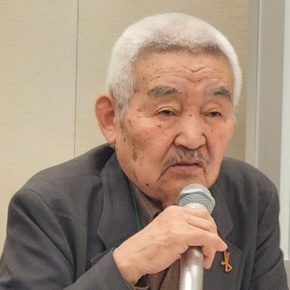
鈴木 江理子さん 国士舘大学教員 / NPO法人移住者と連帯する全国ネットワーク(移住連)共同代表理事
自治体の予算は、公共性を原則として、住民の生活と福祉を守るために使われるものである。公費による事業が、地域に暮らす人びとを傷つけたり、差別を助長したり、分断を生み出したりするようなことがあってはならない。
これは、すべての人の尊厳と豊かな地域社会を取り戻すための訴訟である。

おわりに
この裁判は、一つのアンケートへの公金支出だけを問うものではありません。外国籍住民の権利や尊厳に関わる問題を、当事者を除外したまま多数の意見によって決めてよいのか、そして、行政が根拠の明らかでない不安を広げ、排除につながる政策を進めてよいのかを問う裁判です。
訴訟を続け、問題を広く社会に伝えていくためには、裁判事務、専門家による意見書、報告集会や周知活動などに多くの費用が必要です。皆さまからの一口一口のご寄付が、法廷で声を上げ続けるための大きな支えになります。
国籍にかかわらず、誰もが地域社会の一員として尊重され、安心して暮らせる未来を次の世代につなぐために、どうか温かいご支援をお願いいたします。
*Translated by google translate
Introduction
On December 25, 2025, the Governor of Mie Prefecture announced at a press conference that he would consider reinstating the nationality requirement for hiring prefectural employees, citing measures to prevent information leaks within the prefectural government. This announcement is a serious issue that threatens the dignity of foreign residents who have lived together with the local community in Mie Prefecture.
Furthermore, the prefecture conducted a survey excluding foreign residents from the respondents, asking whether it was appropriate to continue employing foreign nationals, and spent public funds on conducting the survey. Various organizations and individuals have raised their voices in protest, but the consideration of reinstating the nationality requirement has not yet been withdrawn.
To create and protect a society where everyone, regardless of nationality, can live in peace without exclusion, we filed a residents' lawsuit against the Governor of Mie Prefecture at the Tsu District Court on June 11, 2026.
Background
In fiscal year 1999, Mie Prefecture abolished the nationality requirement for hiring, with the exception of certain job categories, with the aim of promoting the social participation of foreigners.
However, at a press conference on December 25, 2025, the Governor of Mie Prefecture announced that he would consider reinstating the nationality requirement, citing the need for risk management to prevent the leakage of sensitive information such as infrastructure strength and the development of new agricultural varieties, as well as national information that may be leaked abroad through local governments. He cited the existence of laws in various countries that obligate their citizens, both domestically and internationally, to cooperate in intelligence activities as the background to this decision.
Furthermore, in order to proceed with the review, the prefecture designed and implemented a section in its "Mie Prefecture Residents' Survey of 10,000 People," which has been conducted for approximately 20 years, to ask residents for their opinions on the reinstatement of the nationality requirement.
▲ Question 16 from the "4th Mie Prefecture 10,000-Person Survey" asking whether or not to continue employing foreign national staff.
Furthermore, by using the "voter register" to select the respondents for the survey, "foreign residents" who are considered "prefectural residents" under the Local Autonomy Act were excluded from the survey.
Regarding issues concerning the rights of foreign residents, bar associations and human rights organizations have strongly protested against the fact that opinions were solicited without the parties involved, and that the content of the questions linked foreign nationals to the risk of information leakage. They argued that this constitutes "unjust exclusion and discrimination based on nationality" and that "confidentiality obligations are equally imposed regardless of whether one is Japanese or not," and issued numerous statements demanding their withdrawal. (Examples: Statement by the Mie Prefectural Bar Association , statement by the Chairman of the Chubu Federation of Bar Associations, statement by the President of the Aichi Prefectural Bar Association , statement by the President of the Japan Federation of Bar Associations )
While the prefectural government's summer civil service examination in 2026 will continue to allow foreign nationals to take the exam, the Governor of Mie Prefecture is still considering the possibility of reinstating the nationality requirement.
What they are claiming in court
This case is being contested as a residents' lawsuit.
On April 28, 2026, Mie Prefecture spent 7,426,100 yen as outsourcing fees for the "Mie Prefecture Residents 10,000 Survey" (hereinafter referred to as "the Survey"). The plaintiffs argue that the survey, which excluded foreign residents from the respondents and contained discriminatory content, and the expenditure of public funds for it, were illegal.
Furthermore, the plaintiffs are demanding that the defendant, the Governor of Mie Prefecture, return an amount equivalent to the commissioned fee for the survey work to Mr. Katsuyuki Ichimi personally.
The main legal points raised by the plaintiff are the following four:
1. Foreign residents were excluded from the survey respondents.
This survey was conducted by selecting participants based on the "voter registration list," and therefore, foreign residents were excluded from the responses.
This violates (1) Article 14, Paragraph 1 of the Constitution, which guarantees the right to equality, and (2) Article 10, Paragraph 2 of the Local Autonomy Act, which guarantees the right of residents to receive services equally from local governments.
Furthermore, ③ it also constitutes "unjust discrimination," which is prohibited by Article 4, Paragraph 1 of the "Ordinance for Eliminating Discrimination and Creating a Mie Prefecture Where Human Rights Are Respected," and is therefore illegal.
An ordinance to eliminate discrimination and create a Mie Prefecture where human rights are respected.
Article 2. In this Ordinance, the meanings of the terms listed in each of the following items shall be as prescribed in the respective items.
1. Attributes such as race: This refers to attributes such as race, skin color, nationality, ethnicity, language, religion, political or other opinions, age, sex, sexual orientation, gender identity, disability, infectious diseases or other illnesses, occupation, social status, origin from a discriminated-against community, and other attributes.
2. Unfair discrimination refers to unfair distinction, exclusion, or restriction based on racial or other attributes, which has the purpose or effect of preventing or impairing the recognition, enjoyment, or exercise of rights and interests in any field.
Article 4. No person shall engage in any act that violates human rights, including unjust discrimination .
Interpretation of "unfair discrimination" (see article-by-article commentary)
(i) refusing to provide goods, services, or opportunities without legitimate reason on the grounds of a person's race or other attributes, restricting the location or time of provision, or imposing conditions that are not imposed on persons who do not possess such race or other attributes; (ii) informing persons with a particular race or other attributes that their life or other rights will be endangered, severely insulting them, or excluding them from the community on the grounds of their race or other attributes (the above constitutes unfair discrimination as defined in Article 2, Paragraph 2); and (iii) acts of human rights violations such as bullying, abuse, invasion of privacy, defamation, sexual harassment, domestic violence (DV), power harassment, and corporal punishment, as well as collecting information about a person's race or other attributes without their consent, and disclosing their attributes without discrepancy (see Article 4, Paragraph 1).
2. The content of Question 16 promotes discrimination and prejudice.
Question 16 explains the possibility of being required to cooperate with intelligence activities under foreign laws and then asks whether the company should continue to employ foreign nationals.
(1) Contents of Question 16
Regarding question 16 of this questionnaire, which concerns the "employment of foreign nationals as prefectural employees," the prefecture provided the following "information":
"In some countries around the world, there are laws that obligate their citizens, both domestically and internationally, to cooperate with their intelligence activities. This raises concerns that even in prefectural government operations that do not involve official authority, there may be cases where the confidentiality obligations of public officials are violated when handling important information such as personal data."
◆"On the other hand, we are currently facing difficulties in securing civil servants due to a shortage of personnel."
After presenting these two points, the question was posed: "Should we continue to employ foreign nationals if the work does not involve official authority?" Regarding the explanations concerning foreign laws and concerns about information leaks, the former (marked with ○) is 128 characters long, while the latter (marked with ◆) only contains 36 characters about the difficulty of securing personnel for public service.
Question 16 undeniably treats all foreign nationals uniformly as "potential spies" and "potential criminals" who could leak information without complying with Japanese law.
Furthermore, since the publication of this survey, discriminatory posts on the internet, such as those calling foreign residents in Japan spies, have increased many times over, and discriminatory sentiments continue to be fueled.
(2) Illegality
Question 16 is illegal because the content itself falls under either (i) "unjust discriminatory speech or actions" as defined in Article 2 of the Hate Speech Elimination Act, or (ii) "racial discrimination" which is prohibited under the International Convention on the Elimination of All Forms of Racial Discrimination.
Hate Speech Elimination Act (Official name: Act on Promotion of Efforts to Eliminate Unfair Discriminatory Speech and Behavior Against Persons of Foreign Origin in Japan)
Article 2. In this Act, "unjust discriminatory speech or conduct against persons of foreign origin" means unjust discriminatory speech or conduct that incites the exclusion of persons of foreign origin from local communities on the grounds that they are of foreign origin, such as publicly announcing an intention to harm their life, body, liberty, honor, or property, or severely insulting persons of foreign origin, with the intent of promoting or inducing discriminatory attitudes against persons of foreign origin who are exclusively from a country or region outside of Japan or their descendants who reside lawfully in Japan (hereinafter referred to in this Article as "persons of foreign origin").
International Convention on the Elimination of All Forms of Racial Discrimination
Article 1 1. In this Convention, “racial discrimination” means any distinction, exclusion, restriction or preference on the basis of race, color, descent or national or ethnic origin which has the purpose or effect of preventing or impairing the recognition, enjoyment or exercise of human rights and fundamental freedoms on an equal footing in the political, economic, social, cultural or any other field of public life.
*In 2004, the Committee on the Elimination of Racial Discrimination adopted General Recommendation 30 on Discrimination Against Non-Citizens, stating that "human rights should, in principle, be enjoyed by all" and that "States Parties have an obligation to ensure, to the extent recognized under international law, equality between citizens and non-citizens in the enjoyment of these rights." (See: https://www.hurights.or.jp/archives/opinion/2004/03/post-4.html )
3. Infringing upon the right of foreign nationals to hold public office.
Question 16 was inserted for the purpose of considering a review of the nationality requirements for hiring prefectural employees, and it infringes upon the right of foreign nationals to hold public office, which is guaranteed by Article 14, Paragraph 1 of the Constitution, Article 22 of the Constitution, and Article 5 of the International Convention on the Elimination of All Forms of Racial Discrimination, and is therefore unconstitutional and illegal.
International Convention on the Elimination of All Forms of Racial Discrimination
Article 5 In accordance with the fundamental obligations set forth in Article 2, the States Parties undertake to prohibit and eliminate all forms of racial discrimination, and to guarantee the right of all to be equal before the law without distinction on the basis of race, color or national or ethnic origin, in particular in the enjoyment of the following rights:
(c) Political rights, in particular the right to participate in elections based on universal and equal suffrage by voting and running for office, to participate in national and all levels of government, and to engage in public service on an equal basis.
(e) Economic, social and cultural rights, in particular,
(i) the right to work, freedom of occupation, fair and favorable working conditions, protection from unemployment, equal pay for equal work and fair and favorable compensation.
4. The Governor of Mie Prefecture exceeded and abused his discretionary powers.
Question 16 was not included in the initial draft questionnaire or the matters to be discussed with experts, and was added just before publication by the Governor of Mie Prefecture acting unilaterally. Furthermore, despite being a matter concerning the right of foreign nationals to hold public office, it was not consulted with an advisory body, and the opinions of the foreign residents who are directly involved were not reflected. These factors underscore the Governor of Mie Prefecture's abuse and exceeding of discretionary power.
Furthermore, concerns about information leaks by foreign national employees can be addressed through criminal penalties and disciplinary actions for violations of confidentiality obligations under the Penal Code and the Local Public Service Act. Despite the fact that there have been no cases of foreign national employees leaking confidential information in Mie Prefecture, conducting a survey that promotes discriminatory attitudes towards foreign nationals constitutes a violation of the principle of proportionality*, and from this point of view, an abuse and exceeding of discretionary power can be recognized.
*Principle of Proportionality: This principle states that when trying to achieve an administrative objective, if the objective can be achieved by means with less regulation, then those less regulated means should be used. It demands a balance between the objective and the means.
Furthermore, this lawsuit is being filed as a residents' lawsuit. Mie Prefecture spent a staggering 7,426,100 yen of public funds on outsourcing the implementation of the aforementioned survey. The plaintiffs argue that the implementation of the survey, which excluded foreign residents from the respondents and contained discriminatory content, and the related expenditure of public funds, were illegal.
Plaintiff's thoughts
Plaintiff: Noboru Takemoto
The Governor of Mie Prefecture conducted the "10,000 Mie Prefecture Residents Survey" with the intention of reversing the previous policy of not hiring foreign residents of Mie Prefecture as prefectural employees, based on the prejudice that foreign residents do not abide by Japanese law and may leak Japanese secrets.
This represents a significant setback to the ideals and spirit of the "Ordinance to Eliminate Discrimination and Create a Mie Prefecture Where Human Rights Are Respected," which we have cherished until now, and is absolutely unacceptable.
I firmly believe that true security can be achieved not through discrimination and xenophobia, but by respecting the human rights of people in other countries and of other ethnicities, and by building peaceful and friendly relations.
The "Mie Prefecture Residents' Survey," which deliberately excluded residents with foreign nationality from the survey and seemed to lead respondents to the conclusion that nationality requirements are necessary for hiring prefectural employees, should never be tolerated and should be immediately withdrawn.
social significance
The primary significance of this trial lies in preventing the government from spreading prejudice against foreign residents and creating divisions within local communities.
In 1999, Mie Prefecture largely eliminated nationality requirements for hiring prefectural employees, and has since welcomed foreign residents as contributors to the local community. However, if the risk of information leakage is linked to nationality and the doors to employment are closed, it could send a message that all foreign nationals are treated as "dangerous." Exclusion by the government could lead to a chain reaction of further exclusion in the workplace, schools, and local communities.
Preventing information leaks is crucial. However, information leaks can occur regardless of an employee's nationality. What is needed is effective information management for all employees, including setting access permissions according to their duties and the information they handle, enforcing confidentiality obligations, providing training, and conducting audits. Unilateral exclusion based on nationality is not a fair measure.
Furthermore, the very nature of democracy is being questioned: is it acceptable to decide on issues concerning the rights and dignity of minorities through a majority-rule type survey that excludes those directly affected from the respondents?
In Mie Prefecture, which is experiencing population decline and an aging society, foreign residents are an important part of supporting the community. Protecting an environment where people with ability and motivation can contribute to the community through public service, regardless of nationality, will also lead to ensuring the quality and sustainability of administrative services.
This trial is about choosing a society where everyone can live in peace and security, while protecting the dignity of each individual, rather than a society that doubts and excludes people based on their nationality.
▲Scene from the lawsuit filing announcement meeting
Use of Donations
Litigation administrative costs
Expenses for the legal team's activities (transportation, communication, copying costs, etc.)
Fees for opinion letters: We plan to have experts write opinion letters.
Court report meeting, public awareness and education event for this case
Legal fees, etc.: After using the donations we receive from everyone to cover the various expenses listed above, any surplus will be used for legal fees.
Message from the head of the defense team
"To prevent history from going back!"
Mie Prefecture's groundbreaking policy in 1999, which eliminated or relaxed the "nationality requirement" that limited applicants to Japanese citizens, was a pioneering move nationwide, and I would like to express my deepest respect for it. Furthermore, the enactment of the comprehensive anti-discrimination ordinance, "Ordinance to Eliminate Discrimination and Create a Mie Where Human Rights Are Respected," was an extremely advanced development nationwide and has been highly praised from the perspective of protecting human rights, which emphasizes fairness and respect for all people, as well as from the perspective of international peace. In particular, the policy of eliminating the nationality requirement was extremely significant at a time when the issues of population decline and low birth rates are being seriously addressed.
I have deep doubts about why the nationality requirement is being reinstated now. Our country has strived to restore and advance world peace and the protection of fundamental human rights since the end of the war, and although progress has been slow, it has made progress. It is extremely regrettable that Mie Prefecture, which should be a leading prefecture that values the human rights of its citizens, including foreigners, is taking a step backward. I sincerely hope that we can somehow prevent this setback and that the respect for human rights and the elimination of discrimination among the people living in Mie Prefecture will be advanced even more strongly.
This is why I was given the opportunity to join the defense team in this case.
Lawyer Keiichi Uchikawa
Message from the legal team
The right of foreign nationals to hold public office is a right won through a fierce history of anti-discrimination movements, and is truly an asset for a harmonious society. It is not a right that can be easily taken away in the context of national security.
Furthermore, by using a survey, Mie Prefecture is attempting to shift the blame for its xenophobic policy choices onto the citizens who responded to the survey. However, the review of the nationality requirements for hiring prefectural employees is fundamentally a matter concerning the human rights of foreign nationals, and should not be influenced by the results of a survey.
Through this trial, we aim to clearly voice our opposition to the rise of xenophobia and to restore "coexistence" in our local community.
Introduction of the assigned lawyer
Keiichi Uchikawa, Aichi Prefectural Bar Association, Keizawa Law Office
Yuji Nakatani, Aichi Prefectural Bar Association, Nagoya Joint Law Office
Hiroko Tamaki, Aichi Prefectural Bar Association, Nagoya Southern Law Office
Keisuke Baba, Mie Prefectural Bar Association, Rivera Law Office
Myung-Ae Kim, Mie Prefectural Bar Association, Rivera Law Office
Yong-Woo Kwak, Aichi Prefectural Bar Association, Nagoya Joint Law Office
Tatsuru Kobayashi, Aichi Prefectural Bar Association, Nagoya First Law Office
Messages of support
Hiroshi Tanaka, Professor Emeritus, Hitotsubashi University
It is a grave mistake to exclude foreign residents from the "Mie Prefecture 10,000-Person Survey," which uses public funds from the prefecture. Can we allow such discrimination to continue? We ask for your support for the sake of a harmonious society in Japan going forward.
Eriko Suzuki, Faculty Member at Kokushikan University / Co-Representative Director of the NPO National Network for Solidarity with Migrants (Migrants' Network)
Local government budgets are, in principle, for the public good and are used to protect the lives and welfare of residents. Publicly funded projects must not harm the people living in the community, promote discrimination, or create division.
This is a lawsuit to restore dignity to all people and to restore a vibrant community.
In conclusion
This trial is not merely about the expenditure of public funds on a single survey. It questions whether it is acceptable to make decisions on issues concerning the rights and dignity of foreign residents based on the opinions of the majority without excluding those directly affected, and whether it is acceptable for the administration to promote policies that spread unfounded anxieties and lead to exclusion.
In order to continue the lawsuit and bring the issue to the attention of society, we need a lot of money for court procedures, expert opinions, reporting meetings, and public awareness campaigns. Every donation you make will be a great support in keeping our voices heard in court.
Regardless of nationality, we ask for your warm support to ensure that we can pass on to future generations a future where everyone is respected as a member of the community and can live in peace.

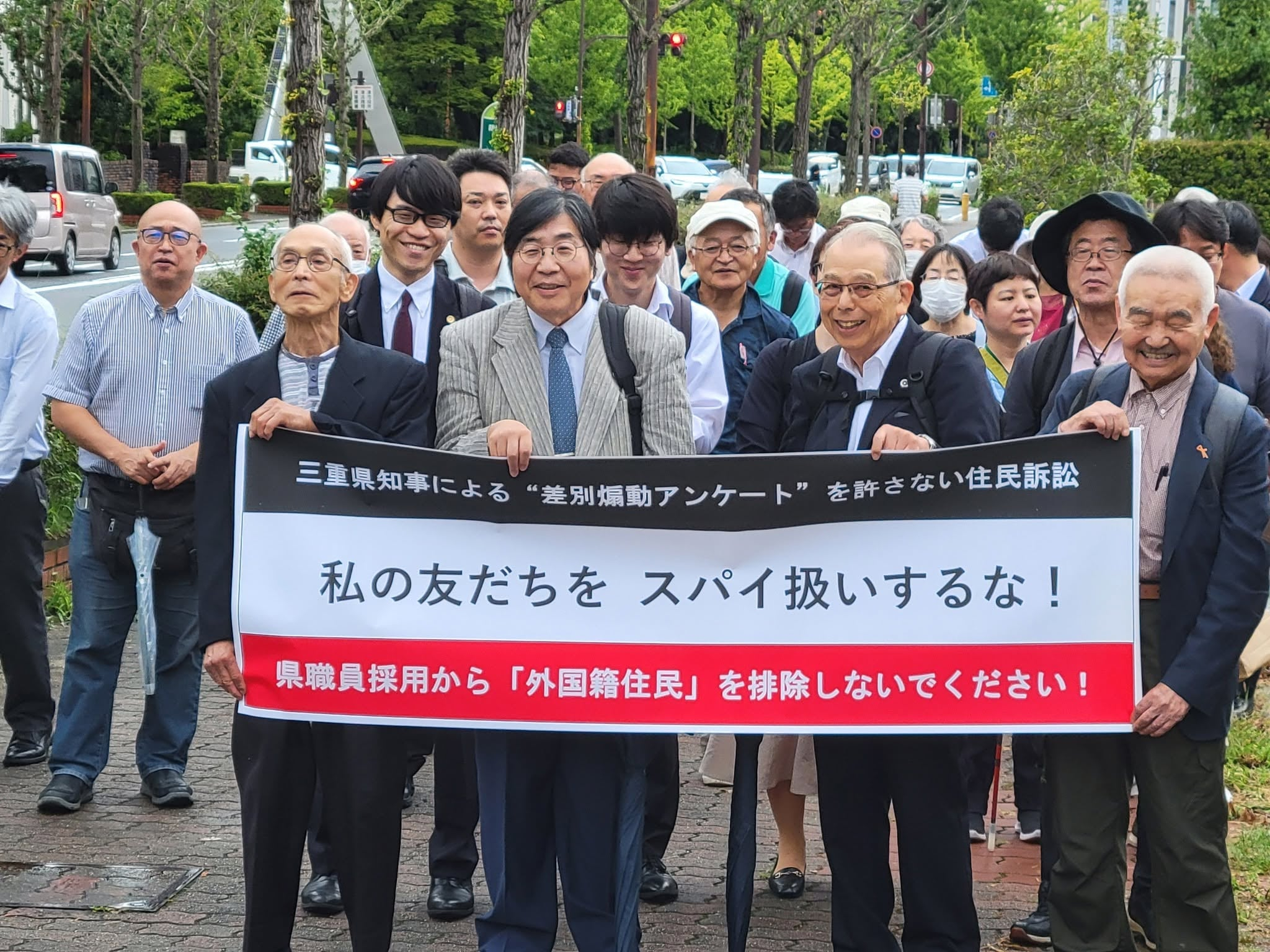
三重県差別アンケート支出返還訴訟弁護団
三重県では国籍要件を復活し外国籍職員の採用を見直す方針が表明されるとともに、その検討材料として県民に対するアンケートが実施されました。
今般、三重県差別アンケート支出返還訴訟弁護団は、当該アンケートの是非を司法の場で問うため、提訴しました。ぜひ、応援をお願いいたします。
弁護士 金 銘愛
(三重県四日市市・リベラ法律事務所・059-351-8001)
今般、三重県差別アンケート支出返還訴訟弁護団は、当該アンケートの是非を司法の場で問うため、提訴しました。ぜひ、応援をお願いいたします。
弁護士 金 銘愛
(三重県四日市市・リベラ法律事務所・059-351-8001)
あなたにおすすめのケース Recommended case for you




- 外国にルーツを持つ人々 Immigrants/Refugees/Foreign residents in Japan
- ジェンダー・セクシュアリティ Gender/Sexuality
- 医療・福祉・障がい Healthcare/Welfare/Disability
- 働き方 Labor Rights
- 刑事司法 Criminal Justice
- 公正な手続 Procedural Justice
- 情報公開 Information Disclosure
- 政治参加・表現の自由 Democracy/Freedom of Expression
- 環境・災害 Environment/Natural Disasters
- 沖縄 Okinawa
- 個人情報・プライバシー Personal information/Privacy
- アーカイブ Archive
- 全てのケース ALL